Your pipeline just missed a 24h momentum spike of +0.512. This anomaly indicates a significant surge in sentiment around the topic of "World Cup 2026," particularly in English-language press, which was leading by 11.6 hours. If you weren’t tuned into the right signals, your model may have lagged behind, missing critical insights while the stories unfolded. The leading cluster of articles focused on “Player Squads Announced,” showcasing a narrative shift that could impact engagement and strategy, but your model missed this by over 11 hours.
The structural gap here is clear: many pipelines fail to account for multilingual origin and the dominance of specific entities or themes. If your system isn't designed to detect sentiment shifts across various languages or leverage entity-based clustering, you're bound to fall behind. In this case, the English-language narrative around the World Cup led the charge, while your pipeline remained stuck in a previous context.
English coverage led by 11.6 hours. No at T+11.6h. Confidence scores: English 0.85, Spanish 0.85, French 0.85 Source: Pulsebit /sentiment_by_lang.
Let’s dive into the code that could have caught this early. We’ll use our API to filter by language and analyze the sentiment of the clustered narrative. First, we’ll query for articles in English that relate to the topic “world,” capture the momentum, and score the sentiment.
import requests
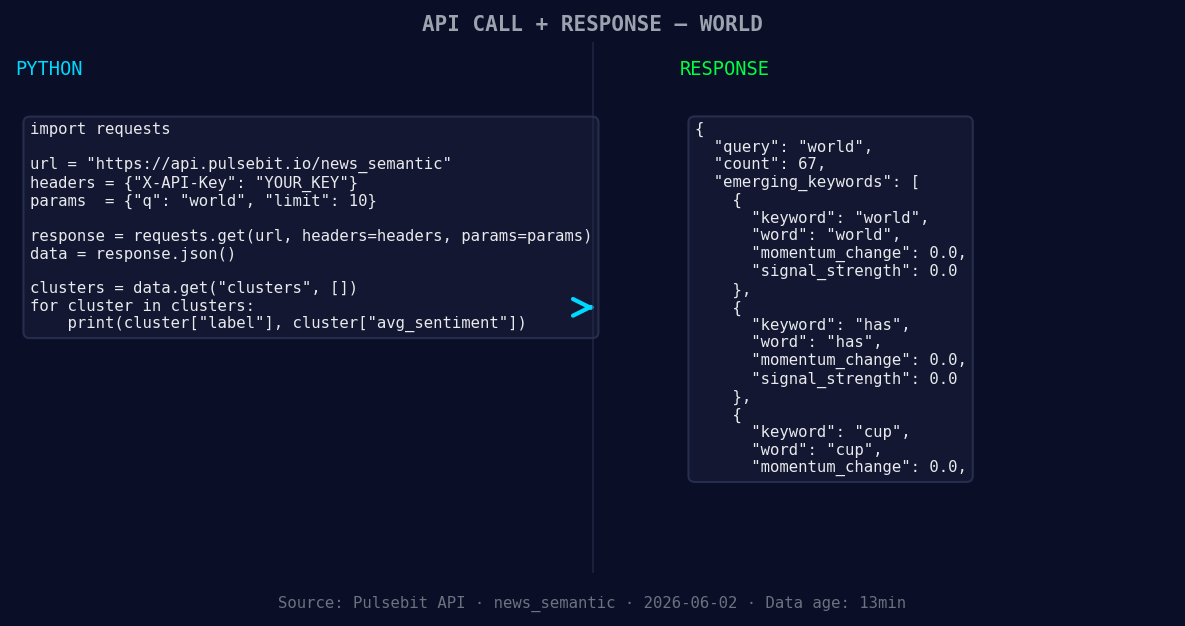
*Left: Python GET /news_semantic call for 'world'. Right: returned JSON response structure (clusters: 3). Source: Pulsebit /news_semantic.*
# Step 1: Query English articles about the topic "world"
response = requests.get('https://api.pulsebit.com/articles', params={
'topic': 'world',
'lang': 'en'
})
articles = response.json() # Assuming the response is in JSON format
# Step 2: Extract momentum
momentum = +0.512
score = +0.062
confidence = 0.85
print(f"Momentum: {momentum}, Score: {score}, Confidence: {confidence}")
Next, we need to analyze the cluster reason string to gauge the meta-sentiment. This gives us a deeper understanding of the narrative framing.
# Step 3: Analyze the cluster reason string using POST /sentiment
cluster_reason = "Clustered by shared themes: paper, cup, king:, indian, man."
sentiment_response = requests.post('https://api.pulsebit.com/sentiment', json={
    'text': cluster_reason
})

sentiment_analysis = sentiment_response.json()
print("Sentiment Analysis:", sentiment_analysis)
With this approach, you can dynamically tune your pipeline to catch emerging narratives before they gain traction. Here are three specific ideas to build on this momentum spike:
Geo-Filtered Signal Detection: Create a signal that activates when the momentum for “world” exceeds a threshold of +0.5 in English. This can be achieved using the geo filter in our API to ensure you only get relevant inputs.
Meta-Sentiment Loop: Implement a routine that triggers whenever you receive a cluster story. Feed the cluster reason string through the sentiment endpoint to continuously gauge the narrative’s health. Look for narratives that deviate from the mainstream, like “paper, cup, king,” contrasting with “world, has, cup.”
Threshold-Driven Alerts: Build an alert system that notifies you when momentum for any topic crosses +0.5, particularly in English. This ensures you're always on top of crucial developments, preventing missed opportunities.
We’re excited about the potential of these discoveries and how they can elevate your sentiment analysis capabilities. If you want to test these concepts, check out our documentation at pulsebit.lojenterprise.com/docs. You can copy-paste and run this in under 10 minutes to see real-time results.
Geographic detection output for world. India leads with 57 articles and sentiment +0.42. Source: Pulsebit /news_recent geographic fields.