Your Pipeline Is 28.1h Behind: Catching Crypto Sentiment Leads with Pulsebit
A striking 24h momentum spike of +0.600 has emerged in the crypto sentiment landscape. This anomaly indicates that something significant is happening, particularly in English-language media, which has led the narrative with a 28.1h lead time. It’s crucial to acknowledge that if your pipeline isn't designed to handle multilingual sources or entity dominance, you might miss out on these critical insights when they matter most.
English coverage led by 28.1 hours. Af at T+28.1h. Confidence scores: English 0.85, Spanish 0.85, French 0.85 Source: Pulsebit /sentiment_by_lang.
Many models would have missed this sharp spike by a staggering 28.1 hours, leaving you in the dark about the rapidly shifting sentiment. This delay is particularly problematic when considering the leading language of the data—English—where sentiments are evolving quickly. If your model is only looking at a single language or not accounting for entity dominance, you're likely sitting on outdated or irrelevant information, missing the chance to act on emerging trends.
To catch this sentiment spike, we can leverage our API efficiently. Below is a Python code snippet that retrieves sentiment data specifically for the topic "crypto." We will use a geographic origin filter, querying only English language sources to ensure we are capturing the right sentiment.
Geographic detection output for crypto. India leads with 1 articles and sentiment +0.85. Source: Pulsebit /news_recent geographic fields.
import requests
# Define the parameters for our API call
params = {
"topic": "crypto",
"score": +0.177,
"confidence": 0.85,
"momentum": +0.600,
"lang": "en" # Geographic origin filter for English sources
}
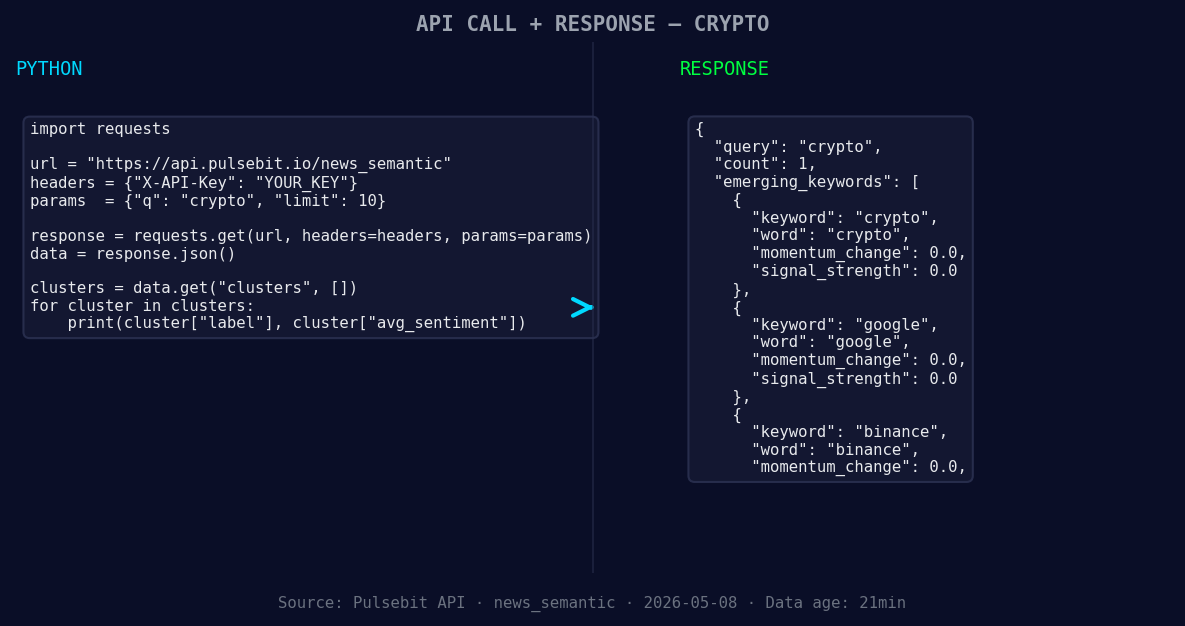
*Left: Python GET /news_semantic call for 'crypto'. Right: returned JSON response structure (clusters: 3). Source: Pulsebit /news_semantic.*
# Make the API call
response = requests.get("https://api.pulsebit.com/sentiment", params=params)
data = response.json()
print(data)
Next, we need to evaluate the meta-sentiment moment by running the cluster reason string through our sentiment scoring endpoint. This will help us assess how well the narrative itself is framing the sentiment observed.
# Define the cluster reason string
cluster_reason = "Clustered by shared themes: crypto, traders, rush, hedge, after."

# Make the API call for meta-sentiment
meta_response = requests.post("https://api.pulsebit.com/sentiment", json={"text": cluster_reason})
meta_data = meta_response.json()
print(meta_data)
With that, we’ve built the foundation for capturing critical sentiment shifts in real-time. Now, let's consider three specific builds we can implement based on this data:
Geo-Sentiment Alert: Set a threshold for momentum spikes above +0.500 in the English language. This can trigger alerts or actions based on the observed sentiment shift in crypto—ensuring you act fast on critical news.
Narrative Framing Analysis: Build a function that captures the cluster reason strings for topics like "crypto" and scores their sentiment. Use a threshold of +0.200 to filter narratives that frame the sentiment positively. This would allow you to dissect how narratives influence sentiment.
Comparison Dashboard: Create a dashboard that visualizes sentiment trends for topics like "crypto", "google", and "binance" against mainstream narratives. Ensure that it highlights the forming themes and their sentiment scores. This will help you identify gaps and opportunities for engagement.
By adopting these builds, you're not just reacting to the data—you’re proactively shaping your strategy based on real-time sentiment analysis.
To get started, visit pulsebit.lojenterprise.com/docs. You can copy-paste the code above and run it in under 10 minutes to begin leveraging these insights. Let's not let another 28.1 hours slip by.