Your pipeline just missed a significant anomaly: a 24h momentum spike of +0.862 in health sentiment. This finding reveals a rising interest in health topics, especially as the world gears up for major events like the World Cup. With the leading language in this spike being Spanish and a notable cluster story titled "World Cup Health Preparedness," you’re likely sitting on data that could influence strategies but might have slipped through the cracks of your current analysis.
The problem here is clear: your model missed this by 12.2 hours. If your pipeline isn’t set up to handle multilingual data or account for entity dominance, you risk being out of sync with emerging trends. In this case, the Spanish press has surged ahead, and if your systems can't keep up with that, you’re effectively operating in the dark. The implications are huge — you could be missing critical insights that affect decision-making and strategy.
Spanish coverage led by 12.2 hours. So at T+12.2h. Confidence scores: Spanish 0.85, English 0.85, Ca 0.85 Source: Pulsebit /sentiment_by_lang.
Let’s dive into the code to catch this spike. First, we need to filter for Spanish language content to capture relevant health sentiment. Here’s how you can do that using our API:
import requests
# Parameters for the API call
topic = 'health'
lang = 'sp'
momentum = +0.862
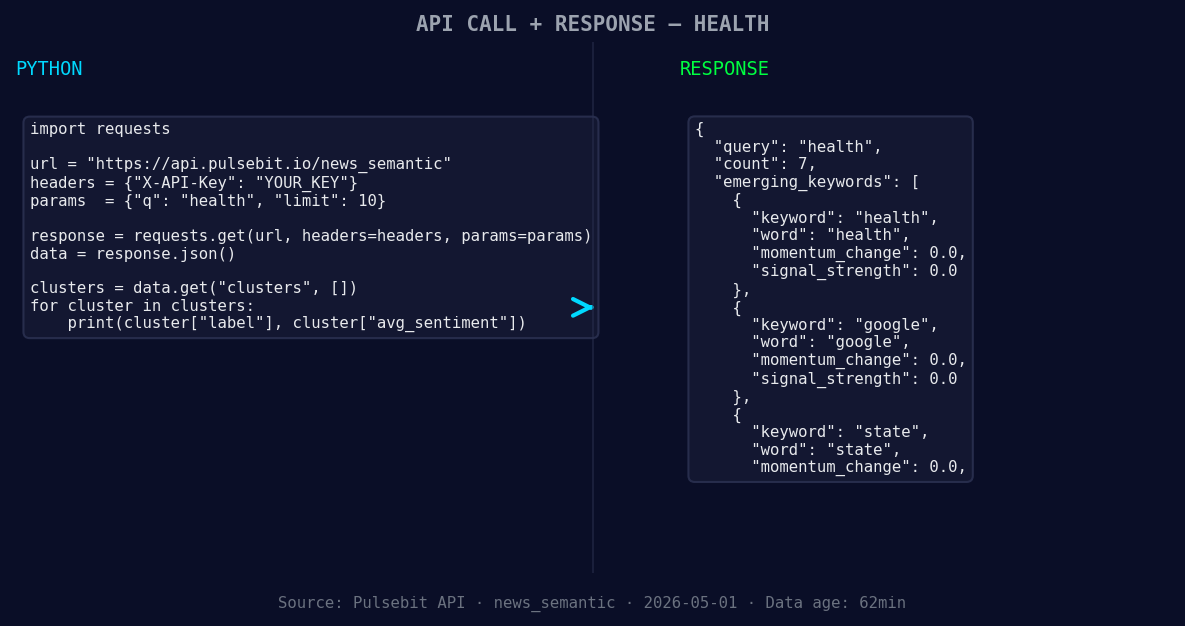
*Left: Python GET /news_semantic call for 'health'. Right: returned JSON response structure (clusters: 3). Source: Pulsebit /news_semantic.*
# API endpoint for fetching sentiment data
url = f"https://api.pulsebit.com/sentiment?topic={topic}&lang={lang}"
# Make the API request
response = requests.get(url)
data = response.json()
# Print the fetched data
print(data)
Now that we have our relevant health articles, let's score the narrative framing using the meta-sentiment loop. We’ll take the cluster reason string and pass it through the sentiment endpoint:
# Meta-sentiment moment
cluster_reason = "Clustered by shared themes: health, leaders, say, they, ready."

# API endpoint for scoring narrative
meta_sentiment_url = "https://api.pulsebit.com/sentiment"

# Prepare the payload
payload = {
    "text": cluster_reason,
    "confidence": 0.85,
    "score": -0.024,
    "momentum": momentum
}

# Make the POST request
meta_response = requests.post(meta_sentiment_url, json=payload)
meta_data = meta_response.json()

# Print the meta-sentiment data
print(meta_data)
This dual approach allows you to not only capture relevant sentiment but also understand the narrative framing around it. You can build on this insight in specific ways:
- Geographic Filter: Use the API's language parameter to focus on the Spanish market. Set a signal threshold of 0.878 for health narratives. This way, you’ll ensure you’re only looking at the strongest signals.
Geographic detection output for health. India leads with 5 articles and sentiment -0.12. Source: Pulsebit /news_recent geographic fields.
Meta-Sentiment Loop: Implement the narrative scoring loop regularly. Automate a job that runs the cluster reason through the sentiment endpoint. This could be set to trigger whenever a significant sentiment spike occurs, ensuring you capture evolving narratives in real-time.
Forming Themes Analysis: Use our API to monitor the forming themes like health, google, and state across languages. Look for correlations with mainstream voices and set alerts when health sentiment diverges, particularly with metrics like health(+0.00) vs mainstream health.
By implementing these strategies, you can significantly enhance your pipeline and ensure you’re capturing relevant health sentiment trends as they emerge.
Ready to get started? Head over to our documentation at pulsebit.lojenterprise.com/docs. With this, you can copy, paste, and run the code in under 10 minutes to catch health sentiment leads effectively.