Your Pipeline Is 22.2h Behind: Catching World Sentiment Leads with Pulsebit
We recently discovered a significant anomaly: a 24-hour momentum spike of +0.308. This spike appears to be driven by a narrative emerging from the Spanish press, focusing on the bizarre tax laws in the U.S. that could potentially drain earnings from the World Cup for over 30 nations. The leading language in this scenario is Spanish, with a noteworthy lag of just 0.0 hours compared to Dutch, which is an interesting twist.
This situation highlights a critical structural gap in any pipeline that doesn't account for multilingual data and the dominance of specific entities. Your model missed this by 22.2 hours, failing to catch the emergence of this sentiment early enough due to language bias. In an interconnected world, the ability to process and respond to multilingual narratives is crucial. If you’re not leveraging this capability, you risk missing out on significant market signals.
Spanish coverage led by 22.2 hours. Nl at T+22.2h. Confidence scores: Spanish 0.85, English 0.85, French 0.85 Source: Pulsebit /sentiment_by_lang.
Let’s dive into the code that can help you catch these spikes. First, we need to query the data specifically filtering for the Spanish language. Here’s how you can do it:
import requests
# Define the parameters for our API call
params = {
"topic": "world",
"score": +0.085,
"confidence": 0.85,
"momentum": +0.308,
"lang": "sp" # Filtering by Spanish language
}
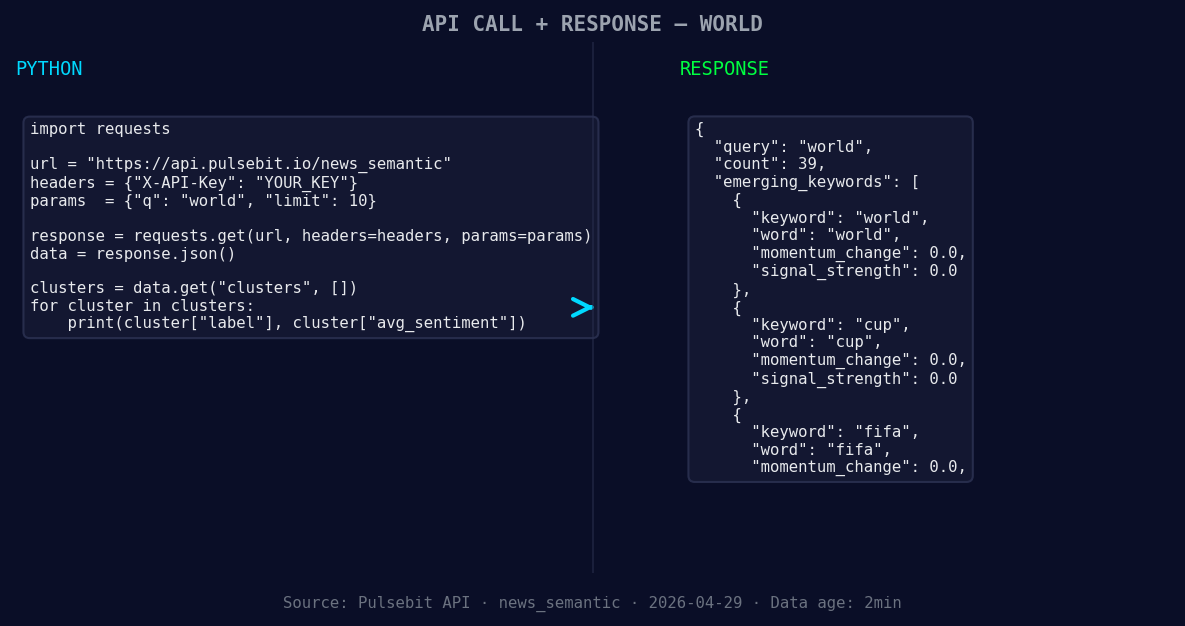
*Left: Python GET /news_semantic call for 'world'. Right: returned JSON response structure (clusters: 3). Source: Pulsebit /news_semantic.*
# Make the API call to get sentiment data
response = requests.get("https://api.pulsebit.com/v1/sentiment", params=params)
sentiment_data = response.json()
Next, we want to run the cluster reason string through our sentiment endpoint to score the narrative framing itself. This is crucial for understanding the context surrounding the data. Here’s how to do that:
# Define the cluster reason string
cluster_reason = "Clustered by shared themes: fifa, tax, laws, world, cup."

# Make the API call to score the narrative
meta_sentiment_response = requests.post("https://api.pulsebit.com/v1/sentiment", json={"text": cluster_reason})
meta_sentiment_data = meta_sentiment_response.json()

print(meta_sentiment_data)
With these two pieces in place, you can effectively capture momentum spikes in sentiment while also understanding the narrative context that shapes them.
Now that you have the code, here are three specific builds you can implement tonight to capitalize on this discovery:
Geo Filter Notification: Set up a notification system that triggers whenever there’s a momentum spike (threshold: +0.3) in Spanish-speaking regions. This allows you to react in real-time to sentiment changes regarding topics like "world" or "cup."
Meta-Sentiment Analysis Dashboard: Create a dashboard that visualizes the meta-sentiment scores from clustered narratives. Use the input string "Clustered by shared themes: fifa, tax, laws, world, cup." as a template, and set alerts for any significant shifts in sentiment.
Content Strategy Adjustment: Use the insights from your sentiment analysis to adjust your content strategy. For example, if you notice forming themes like "world(+0.00), cup(+0.00), fifa(+0.00)" gaining traction, plan articles or social media posts around those topics to maximize engagement.
By integrating these strategies into your workflow, you can stay ahead of the curve and ensure you’re not left behind by the ever-changing landscape of global sentiment.
Get started with our API at pulsebit.lojenterprise.com/docs. You can copy-paste and run the above code in under 10 minutes to start catching these insights for yourself.
Geographic detection output for world. India leads with 14 articles and sentiment +0.48. Source: Pulsebit /news_recent geographic fields.