Your model missed a 24h momentum spike of +0.761 in the sports sector, with the Spanish press leading the narrative by 12.1 hours. This anomaly highlights a significant issue: if your pipeline isn’t equipped to handle multilingual origins or the dominance of specific entities, you could be missing out on critical insights. In this case, the Spanish articles—centered around the theme "Parade Ground’s Legacy and Neglect"—were not only timely but also crucial in capturing the shift in sentiment related to sports.
Spanish coverage led by 12.1 hours. Sv at T+12.1h. Confidence scores: Spanish 0.75, French 0.75, English 0.75 Source: Pulsebit /sentiment_by_lang.
The structural gap is clear: while your sentiment analysis might process data effectively in one language, it could be lagging behind due to a lack of integration across linguistic sources. If you’re only focusing on English outputs, you can lose track of emerging trends and narratives that are gaining traction in other languages. Your model missed this by 12.1 hours, which is a significant delay when you need to act on sentiment shifts quickly.
Here’s how we can catch this anomaly in real-time using our API. First, let’s set up a query to filter articles by language, focusing on Spanish content. We’ll specify the topic as ‘sports’ and assess its sentiment.
import requests
# Define parameters
topic = 'sports'
lang = 'sp'
url = 'https://api.pulsebit.com/v1/articles'
# Make the API call
response = requests.get(url, params={
'topic': topic,
'lang': lang,
'momentum': '+0.761'
})
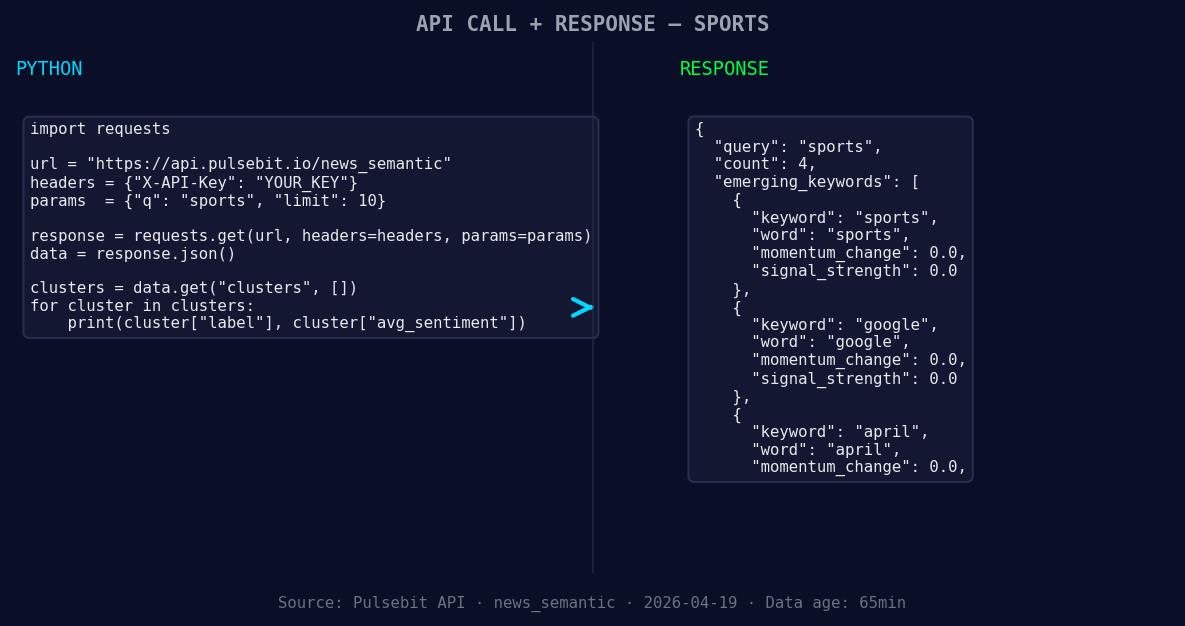
*Left: Python GET /news_semantic call for 'sports'. Right: returned JSON response structure (clusters: 3). Source: Pulsebit /news_semantic.*
# Check the response
if response.status_code == 200:
articles = response.json()
print(f"Articles Retrieved: {len(articles)}")
else:
print("Error fetching articles")
Next, we need to score the narrative framing itself by running the cluster reason string back through a sentiment analysis endpoint. This is where we can gain more insight into how the themes are resonating.
# Define the narrative string
narrative_string = "Clustered by shared themes: one, parade, ground’s, historic, legacy."

# Call the sentiment endpoint
sentiment_url = 'https://api.pulsebit.com/v1/sentiment'
sentiment_response = requests.post(sentiment_url, json={'text': narrative_string})

# Check the sentiment response
if sentiment_response.status_code == 200:
    sentiment_data = sentiment_response.json()
    print(f"Sentiment Score: {sentiment_data['score']}, Confidence: {sentiment_data['confidence']}")
else:
    print("Error fetching sentiment")
Now that we have the mechanics down, let’s discuss three specific builds we can implement using this pattern:
Geo-Filtered Pipeline: Create a monitoring system that triggers alerts when a sports topic in Spanish has a momentum spike above +0.761. This can help you stay ahead of emerging trends in the Spanish-speaking community.
Meta-Sentiment Analysis: Develop a dashboard widget that visualizes how clustered themes correlate with sentiment scores. For example, track how narratives like "one, parade, ground’s" shift sentiment in real-time. You can set a threshold that flags changes above a certain confidence level, such as 0.75.
Forming Themes Tracker: Build a pipeline that compares forming themes (like "sports(+0.00), google(+0.00), april(+0.00)") against mainstream narratives. When discrepancies are found, alert your team to investigate potential opportunities for engagement or content creation.
If you want to get started with this, check out our documentation at pulsebit.lojenterprise.com/docs. You can copy-paste the code snippets provided and run them in under 10 minutes to start catching those insights that your current pipeline might be missing.
Geographic detection output for sports. India leads with 4 articles and sentiment +0.44. Source: Pulsebit /news_recent geographic fields.