Your pipeline just missed a 24h momentum spike of +0.336 in sustainability sentiment. This spike, led by the Spanish press, indicates a significant shift in how people are perceiving sustainability, particularly in the context of H&M's potential to prove sustainability as a growth engine. With a lag of 22.4 hours, it’s clear that ignoring multilingual origin or entity dominance can result in missing critical insights. Your model, which presumably focuses solely on English-language sources or fails to account for entity relevance, just overlooked a major sentiment shift that could have informed your strategies.
Spanish coverage led by 22.4 hours. Nl at T+22.4h. Confidence scores: Spanish 0.85, English 0.85, French 0.85 Source: Pulsebit /sentiment_by_lang.
The problem is straightforward: if your pipeline isn’t designed to handle multilingual data and doesn’t prioritize dominant entities, you’re looking at a structural gap that can cost you valuable insights. In our case, it’s a 22.4-hour gap in recognizing a rising sentiment in the Spanish-speaking market. That’s a critical oversight, especially when the leading language is Spanish and the dominant entity driving this conversation is H&M. The implications of this can extend to missed opportunities in product development, marketing strategies, or even stakeholder engagement.
Let’s look at how we can harness this momentum spike using our API. First, we can capture the relevant sentiment data by filtering for the Spanish language. Here’s how to do it in Python:
import requests
# Define the API endpoint and parameters
url = "https://api.pulsebit.com/v1/sentiment"
params = {
"topic": "sustainability",
"score": 0.725,
"confidence": 0.85,
"momentum": 0.336,
"lang": "sp" # Spanish language filter
}
# Make the API call
response = requests.get(url, params=params)
data = response.json()
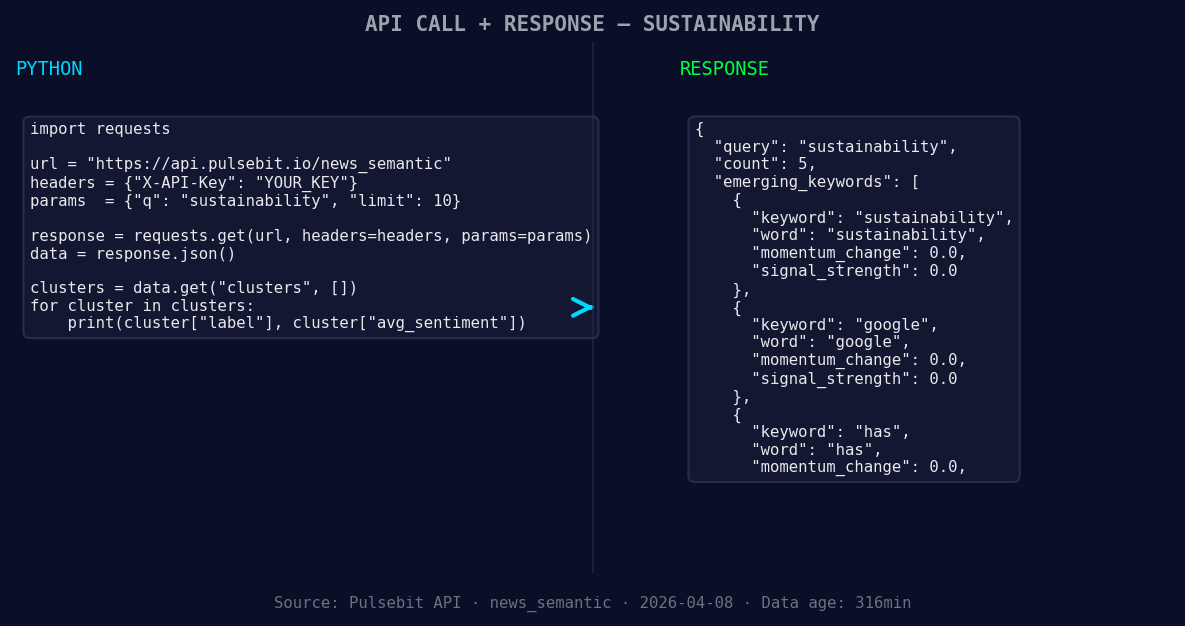
*Left: Python GET /news_semantic call for 'sustainability'. Right: returned JSON response structure (clusters: 3). Source: Pulsebit /news_semantic.*
print(data)
Next, we need to analyze the narrative framing of our clustered themes. We can run the cluster reason string through our sentiment analysis endpoint to score its relevance:
# Define the narrative framing string
narrative = "Clustered by shared themes: prove, sustainability, growth, engine?, business."

# Make the API call for meta-sentiment
meta_sentiment_url = "https://api.pulsebit.com/v1/sentiment"
meta_params = {
    "input": narrative
}

meta_response = requests.post(meta_sentiment_url, json=meta_params)
meta_data = meta_response.json()

print(meta_data)
This gives us not just the sentiment of the topic but also the context in which it’s being discussed, enhancing our overall understanding of the market dynamics.
Now, let’s discuss three specific builds you can implement with this data pattern:
Geo-Filtered Trend Analysis: Build an alert system that triggers when the sentiment score for sustainability in Spanish exceeds a threshold of +0.725. You could set up a webhook that listens for significant changes in sentiment, filtering exclusively for Spanish-language sources. This ensures you're always in tune with the leading discourse in key markets.
Meta-Sentiment Integration: Create a dashboard that visualizes sentiment scores alongside meta-sentiment scores. You can use the meta-sentiment analysis to identify how effectively the narrative themes are resonating with the audience. For instance, if the meta score for sustainability-related narratives is above +0.5, it indicates a strong positive framing that could be leveraged in marketing campaigns.
Clustered Content Strategy: Develop a content recommendation engine that utilizes the clustered themes. For example, if the forming themes are sustainability, Google, and H&M with scores close to +0.00, you could prioritize content creation around these topics. This would ensure your content strategy is aligned with emerging trends and sentiments.
By leveraging our API effectively, you can ensure that your sentiment analysis pipeline does not just react to trends but anticipates them, catching insights before they become mainstream conversations.
You can get started by checking our documentation at pulsebit.lojenterprise.com/docs. With the provided code snippets, you should be able to copy-paste and run this in under 10 minutes, ensuring you’re always on top of the latest sentiment trends.
Geographic detection output for sustainability. India leads with 5 articles and sentiment +0.81. Source: Pulsebit /news_recent geographic fields.